Posts

Showing posts with the label Bible

Happy Passover?

Image
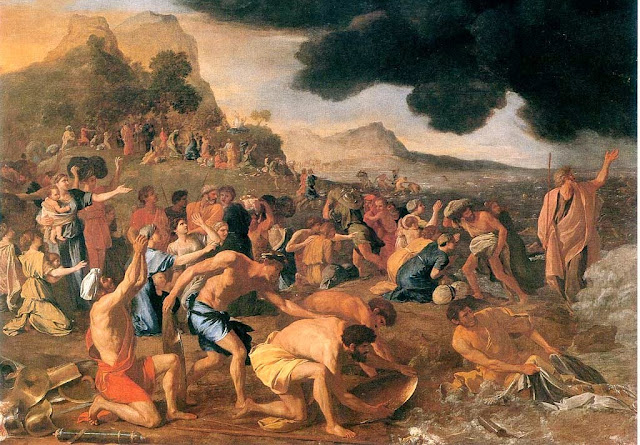
Passover begins tonight, that joyous time of year when Jews the world over remind themselves of how great Yahweh is. At least that's what Yahweh wants them and the adherents of the offshoot religions, Christianity and Islam, to do. In the relevant text, Yahweh repeatedly reminds readers that he is the one who led them out of slavery in Egypt to the Promised Land. The warning is clear: do not forget what Yahweh did for you -- not only your distant ancestors but you  -- or you're a bad person and will suffer severe consequences. But is that the whole story? In this post I am taking the book of Exodus, which is excerpted in the Haggadah, which Jews read at their two seders (I've been there), at face value. Needless to say (?), there is little or nothing of historical accuracy in that book. Archeologists have failed to find evidence of any kind to support the claim that the Israelites were slaves in Egypt or that a mass exodus from Egypt to Canaan ever occurred. But let's w...

What the Bible Is

Apocrypha of miracles.

Some Thoughts on Christmas Day

This morning I enjoyed watching Robert Mayhew's lecture "Ayn Rand's Intransigent Atheism," which was given at last summer's Objectivist Conference, or OCON. In this examination of the cosmological argument, he says much of what I've tried to say on this blog. Mayhew, a professor of philosophy at Seton Hall University, points out that Ayn Rand called herself an "intransigent" but not a "militant" atheist. Her objective was not, in a primary sense, to argue against or reject belief in God, but to affirm reason as the only method of obtaining knowledge about what exists. One who is fully committed to reason is necessarily an atheist because no room is left for what people mean by God . Her use of the word intransigence indicated that the claims of theism could simply be dismissed as empty nonsense because they misuse the language by ignoring basic metaphysical truths that cannot be escaped without self-contradiction. Rand's orientation i...

Murders, Cruelties, and Assassinations

The character of Mahomet is of a savage, military, and tyrannical cast; but he speaks in the name of heaven, and, like Moses, pretends, that his murders, cruelties, and assassinations have been sanctioned by the divinity which he adores. He frequently begins his chapters in the name of the most merciful God; but, in the course of the chapter, is sure to consign to damnation those who do not accede to the system of revelation which he has received from God. "The chosen people of the Most High", under the Jewish dispensation, took the liberty of exercising a principle of indiscriminate extirpation toward all heathen nations; the Mahometans pursued a similar course in the destructive wars wherever they have been engaged, and to which they have been conducted by their fanatic leaders. The Christian world is not a whit behind either of these two grand divisions in the exercise of a censorious and military spirit. The crusades and the domestic quarrels of the Christian church will ...

Were the First Monotheists Really Monotheistic?

The title is an odd question, I know, but it's worth asking. The Hebrew Bible is full of lines that suggest that the Israelites were being cajoled and threatened into choosing Yahweh from among multiple possible alternatives. According to  My Jewish Learning , the second commandment states in Exodus 20:3-6 is "You shall have no other gods beside Me.... You shall not bow down to [graven images], nor serve them, for I, the Lord Your God, am a jealous God, visiting the iniquity of the fathers upon the children unto the third and fourth generation." Does this sound like a deity claiming to be the one and only? I don't think so. It sounds more like a claim against other deities. And who could Yahweh be jealous of? This sort of idea can be found throughout what is known in Judaism as the Five Books of Moses.  In Exodus 6:6-8, we "hear" Yahweh telling Moses, "I will take you [Israelites] as my own people, and I will be your God." Why wouldn't The One ...

Religion Is Absurd

Yes, religion is absurd. I refer here specifically to the three Abrahamic religions (and their many subdivisions), which are based on the Five Books of Moses and its associated volumes. The stories make no sense, and it's hard to understand why anyone ever took or still takes them seriously. The Bible is literally a string of fables that are laughably implausible and morally outrageous. The six-day creation--yeah, right. Adam and Eve and the tree of the knowledge of good and evil--really? The flood and the resulting mass murder--come on! Lot, his poor wife, the destruction of Sodom and Gomorrah, and Lot's incestuous daughters--x-rated soap opera and gratuitous violence. Does anyone think that stuff actually happened?  How about Abraham's willingness to kill his son Isaac because a voice in his head claiming to be Yahweh's told him to do it. Please. Like Abraham wouldn't have been appalled by the very idea and wouldn't have torn up the covenant in which he promis...

Read Your Bible

I can think of only two reasons to read the Bible(s), namely, to: be entertained; see how gullible mankind can be.  Good storytelling? Nope.  Good moral lessons? Not a chance.  History? Fuggedaboutit. We're talking about books full of stories that are evil, vicious, or just downright silly. It's just one long collection of sketch or movie ideas for Monty Python.

Why Do They Call It the Good Book?

The other day I raved about Hemant Mehta's "Friendly Atheist" YouTube series "Everything Wrong with ...."  I repeat my recommendation here, but I want to add a note. The series is highly entertaining, but don't let that overshadow the deeper message: the Hebrew Bible is full of deeply immoral tales. I don't know why even some secularists concede that it is one of the great works of literature. It is clearly ungreat at every level, but especially at the moral level. God just wasn't into justice as you and I understand it. You will have to look awfully hard to find even one sound moral lesson in Genesis, which is as far as Mehta has gone. (He tells me he plans to keep going, a plan I heartily applaud.) If someone can tell me how the stories of Adam and Eve, Cain and Abel, Noah, Abraham, Lot, and rest teach something worthwhile, I'd like to hear it. Leave me comments. By the way, Mehta refers to the God of Genesis as "the Christian God," b...

A Funny Look at the Bible

If you're looking for an informative, entertaining, irreverent, and even hilarious look at the the Bible, I highly recommend Friendly Atheist's YouTube series "Everything Wrong with...."  (Hemant Mehta has a website too.) As you'll see, just about every line is absurd and uproariously funny -- the book could have been written by the Monty Python gang. It looks like Mehta started a year ago and is just now getting to the end of Genesis. I've watch a few at random and found them brilliant, not to mention educational. He cleaves to the text with the help of good graphics while offering brief droll comments that are always well put. I now plan to watch them all in order. If you want a good sample, see the one on Genesis 19 , where we learn about Sodom and Gomorrah, poor Lot, his doomed wife, and his scheming incestuous daughters. You will have a laugh and go back for more, I'm sure.

Idle, Extravagant, and Useless Stories

The destruction of the cities of Sodom and Gomorrah by fire and brimstone precipitated from Heaven in the form of rain; the blowing down the walls of Jericho with rams' horns, by the triumphant march of the priesthood round the city; the marvellous and frightful story of the witch of Endor; the woeful condition of Daniel in the den of lions; the hot sultry situation of Shadrach and his two companions in the fiery furnace; together with the unnatural and hopeless abode of poor Jonah in the belly of the whale; all these are specimens of that miserable and disgusting extravagance with which this "Holy Bible" is every where replete. These are a few out of the number of that long catalogue of foolish detail for which the scriptures of the Old and New Testament are so remarkable. If any man of the present day, who writes for the instruction and benefit of mankind, were to interlard his works with such idle, extravagant, and useless stories, he would be considered in a state of ...

What Is a Book without Substantiation?

The Christian religion is a compound and combination of all the theological writings of the followers of Moses and Jesus. We have no evidence that either of these men wrote any part, either of the Old or New Testament. From Genesis to the Apocalypse of St. John, a vast variety of fact, fable, principle, wickedness, and error is exhibited to view. The book, though bound together, appears to be in many respects discordant; the historical part has no accurate connection; the moral part is distorted, deficient, or wicked; the doctrinal parts are either unintelligible, or contrary to moral and philosophical truth.... What is a book, whether it be denominated sacred or not, unless the human mind is capable of discovering the evidence by which the truth of such book can be substantiated? The Bible, which means nothing more than a book; the scriptures of the Old and New Testaments, which means nothing more than the heterogeneous writings contained in the former, and the incoherent and unintell...

Do the Scriptures Refute the Case for God?

Do the Hebrew Bible and New Testament provide grounds not only for abstaining from believing in God but, further, for affirmatively believing that God does not exist? I think so. The list of moral outrages detailed in the sacred texts is so long that it ought to prompt believers to engage in the intellectual process that Auburn University philosopher Roderick T. Long (adapting John Rawls's phrase) calls "reflective equilibration." This is the procedure (used by Socrates) in which a person who encounters a logical disturbance in his web of belief undertakes to adjust at least one of the constituent beliefs in order to restore equilibrium to the web. Equilibrium, which will likely be temporary because new evidence in empirical matters can always arise, consists in the constituent ideas not conflicting with one another; they need not affirmatively support one another, but they must not conflict. This is "negative coherence," and it seems to be the best way to acq...

Is He Having a Laugh?

According to the Hebrew Bible and New Testament, the government is God's appointed agent on earth, and each of us owes it allegiance and obedience. If that's so--and I for one don't believe either part of that statement--I'd like some believer to explain what God had in mind when he arranged things so that one of the two major-party clowns running for president will be elected in November. Is He having a laugh?

Design to Defeat Design

The theologian says that what we call evil is for our benefit -- that we are placed in this world of sin and sorrow to develop character. If this is true I ask why the infant dies? Millions and millions draw a few breaths and fade away in the arms of their mothers. They are not allowed to develop character. The theologian says that serpents were given fangs to protect themselves from their enemies. Why did the God who made them, make enemies? Why is it that many species of serpents have no fangs? The theologian says that God armored the hippopotamus, covered his body, except the under part, with scales and plates, that other animals could not pierce with tooth or tusk. But the same God made the rhinoceros and supplied him with a horn on his nose, with which he disembowels the hippopotamus. The same God made the eagle, the vulture, the hawk, and their helpless prey. On every hand there seems to be design to defeat design. If God created man -- if he is the father of us all, why did he ...

The Most Absurd Superstition

Of all the superstitions of mankind, this insanity about the "sacred Sabbath" is the most absurd. The idea of feeling it a duty to be solemn and sad one-seventh of the time! To think that we can please an infinite being by staying in some dark and sombre room, instead of walking in the perfumed fields! Why should God hate to see a man happy? Why should it excite his wrath to see a family in the woods, by some babbling stream, talking, laughing and loving? Nature works on that "sacred" day. The earth turns, the rivers run, the trees grow, buds burst into flower, and birds fill the air with song. Why should we look sad, and think about death, and hear about hell? Why should that day be filled with gloom instead of joy?   A poor mechanic, working all the week in dust and noise, needs a day of rest and joy, a day to visit stream and wood—a day to live with wife and child; a day in which to laugh at care, and gather hope and strength for toils to come. And his weary wife...

A Being Unworthy of the Adoration of Mankind

Another except from Robert G. Ingersoll's "Some Mistakes of Moses" : Let us understand this. An honest finite being uses the best words, in his judgment, to convey his meaning. This is the best he can do, because he cannot certainly know the exact effect of his words on others. But an infinite being must know not only the real meaning of the words, but the exact meaning they will convey to every reader and hearer. He must know every meaning that they are capable of conveying to every mind. He must also know what explanations must be made to prevent misconception. If an infinite being cannot, in making a revelation to man, use such words that every person to whom a revelation is essential will understand distinctly what that revelation is, then a revelation from God through the instrumentality of language is impossible, or it is not essential that all should understand it correctly. It may be urged that millions have not the capacity to understand a revelation, although ex...

The Firmament Was "Where God Lived"

We continue with Robert G. Ingersoll's "Some Mistakes of Moses" : We are next informed by Moses that "God of the waters, and let it divide the waters from the waters;" and that "God made the firmament, and divided the waters which were under the firmament from the waters which were above the firmament." What did the writer mean by the word firmament? Theologians now tell us that he meant an "expanse." This will not do. How could an expanse divide the waters from the waters, so that the waters above the expanse would not fall into and mingle with the waters below the expanse? The truth is that Moses regarded the firmament as a solid affair. It was where God lived, and where water was kept. It was for this reason that they used to pray for rain. They supposed that some angel could with a lever raise a gate and let out the quantity of moisture desired. It was with the water from this firmament that the world was drowned when the windows of heave...

"Inspired, and Therefore True"

Robert G. Ingersoll's "Some Mistakes in Moses" goes on: In the time of Moses, it was perfectly safe for him to write an account of the creation of the world. He had simply to put in form the crude notions of the people. At that time, no other Jew could have written a better account. Upon that subject he felt at liberty to give his imagination full play. There was no one who could authoritatively contradict anything he might say. It was substantially the same story that had been imprinted in curious characters upon the clay records of Babylon, the gigantic monuments of Egypt, and the gloomy temples of India. In those days there was an almost infinite difference between the educated and ignorant. The people were controlled almost entirely by signs and wonders. By the lever of fear, priests moved the world. The sacred records were made and kept, and altered by them. The people could not read, and looked upon one who could, as almost a god. In our day it is hard to conceive ...

"Let Us Wait for the Light"

More from freethinker Robert G. Ingersoll's "Some Mistakes of Moses" : Let us account for all we see by the facts we know. If there are things for which we cannot account, let us wait for light. To account for anything by supernatural agencies is, in fact to say that we do not know. Theology is not what we know about God, but what we do not know about Nature. In order to increase our respect for the Bible, it became necessary for the priests to exalt and extol that book, and at the same time to decry and belittle the reasoning powers of man. The whole power of the pulpit has been used for hundreds of years to destroy the confidence of man in himself—to induce him to distrust his own powers of thought, to believe that he was wholly unable to decide any question for himself, and that all human virtue consists in faith and obedience. The church has said, "Believe, and obey! If you reason, you will become an unbeliever, and unbelievers will be lost. If you disobey, you w...

Religions and Cults

A religion is simply a cult that's accumulated enough years under its belt to be thought respectable. But if you dare to venture back to the origins, you'll see the markings of a cult every time. For example, here's Deuteronomy, chapter 7 , from the Jewish Publication Society's translation of the Tanakh, or Hebrew Bible , which contains the Five Books of Moses and 19 other books (Judges, the various prophets, Kings, etc). Pay special attention to the God-authorized genocide of the inhabitants of Canaan, the animosity toward religious freedom of non-Israelites, the separatism, and the issue of chosenness. ( HaShem is Hebrew for Lord . G-d is how Orthodox Jews spell God ; in that way, should a document be destroyed, the word God would not be destroyed.) 1 When HaShem thy G-d shall bring thee into the land whither thou goest to possess it, and shall cast out many nations before thee, the Hittite, and the Girgashite, and the Amorite, and the Canaanite, and the Perizzite,...